
| Over the past fifty years, Europe and the Middle East have witnessed significant demographic shifts, resulting in increasingly diverse classrooms, with 70% of primary school-age refugees enrolled in school (UNHCR, 2022). Diverse classrooms offer children valuable opportunities to form friendships and engage with peers from different backgrounds, cultures, and experiences (Killen et al., 2013). Such interactions can promote inclusive attitudes and behaviors (Gönültaş & Mulvey, 2023). However, diversity can also introduce opportunities for negative stereotypes, biases, and attitudes to be expressed (Levy & Killen, 2008). When this happens, children’s interactions may devolve into prejudice, discrimination, and exclusionary behaviors—such as intergroup bullying (Demir & Ozgul, 2019). What Is Intergroup Bullying? Intergroup bullying refers to consistent hostile actions aimed at individuals due to their membership in a specific group. This group-based targeting may involve factors such as nationality, immigration/refugee status, religion, gender, sexual orientation, or disability (Palmer & Abbott, 2018). This form of bullying is particularly harmful, often resulting in long-term psychological and educational consequences for those victimized (Killen et al., 2013; Menesini & Salmivalli, 2017). The profound impact of intergroup bullying is highlighted in a qualitative study with Syrian refugee children in Türkiye (Demir & Ozgul, 2019). Some participants shared that, despite being enrolled in school, they rarely attended or had dropped out. For instance, one child explained: “Initially, I attended school, but I don’t do it anymore. That’s because I was mistreated there. They said to me, ‘Go back to Syria. You are not wanted here.’ I felt sorry and decided not to go to school because I would cry all the time.” Another participant described her struggle with integration after immigrating to Türkiye at age five. She said she missed her friends in Syria and had trouble making new ones: “I had a fight with Turkish children and had to leave school. They kept taking away my ball and yelling at me, ‘Chase after the Syrian.’ I fought back, but later I was kicked out of school. I don’t feel like going back. I have lost my motivation. I’m not competent in either Arabic or Turkish, so school makes no sense to me.” These firsthand accounts reveal the devastating emotional and educational toll of intergroup bullying on refugee children, underscoring the importance of understanding and addressing this issue. The Role of Bystanders in Preventing Intergroup Bullying Bystanders play a critical role in either perpetuating or preventing bullying. By intervening, bystanders can challenge the norms that fuel intergroup bullying and create a safer, more inclusive environment (Salmivalli et al., 2011). Yet, stepping in is not always straightforward. The process of intervening involves several complex decisions, as outlined in the five-step intervention model: (1) recognizing the bullying, (2) assessing the situation as an emergency, (3) feeling responsible to intervene, (4) determining the most effective way to help, and (5) taking action (Nickerson et al., 2014). In cases of intergroup bullying, the victim’s identity becomes particularly significant. Refugees, often a visible “out-group,” are frequent targets (Gönültaş & Mulvey, 2019). According to the UNHCR’s Global Trends report, 31.6 million refugees worldwide need international protection, and 40% of them are children (UNHCR, 2023). These refugee children face heightened risks of psychological distress (Bronstein & Montgomery, 2011), and potential intergroup bullying in schools. Building Social Cohesion In host societies, majority group children often wield the social power to either include or exclude others, making their reactions to refugee peers crucial for fostering inclusive classrooms. For example, a simple storybook intervention in which children were asked to focus on the emotions of the protagonist – a Syrian child whose family fled and would be joining their school – resulted in higher prosocial behavior intentions toward the refugee child (Taylor & Glen, 2020). More research is needed to understand if such interventions also work to promote bystander intervention in cases of intergroup bullying. As our societies become increasingly diverse, focusing on how to reduce intergroup bullying and to support children’s prosocial bystander behavior becomes vital. Through evidence-based interventions, we can build inclusive school environments, where all students feel valued, safe, and accepted, that not only celebrate diversity but also promote wider social cohesion. By Serengeti Ayhan, Bilkent University, & Laura K. Taylor, University College Dublin |
Author: helpingkidslab
European Identity in the European Year of Youth: Who are the young ‘Europeans’?
| The Russian invasion of Ukraine has fuelled debate about who is ‘European’. Yet, European identity is an elusive construct. A European identity can offer a sense of belonging to a group larger than the nation, prompting solidarity with a larger collection of people. Youth are more likely to identify as European than their older counterparts; moreover, childhood and adolescence are crucial periods for identity development. Here, we synthesise research on the development of European identity across childhood, adolescence and young adulthood. We conducted a Rapid Evidence Assessment of European identity in 4-25 year olds, to understand (1) how to measure European identity, and what (2) predictors and (3) outcomes are linked with youth’s European identity. The REA included 11 papers from disciplines such as psychology, education and sociology. Across the studies, five themes summarised how European identity is defined and measured in young people (Figure 1). The Complexity of European identity is reflected in the lack of a consistent tool to measure European identity, and permeates the other themes. European identity is also Ascriptive, as youth choose to identify as such, in search of the sense of Belonging that it may bring. European identity is closely related to the EU motto, United in Diversity, as we see both Similarity – such as a shared culture, history, desires and political identity, and Difference – as national subgroups under the ‘European’ umbrella have different historical, cultural and linguistic roots; there is variation in who identifies as European. |
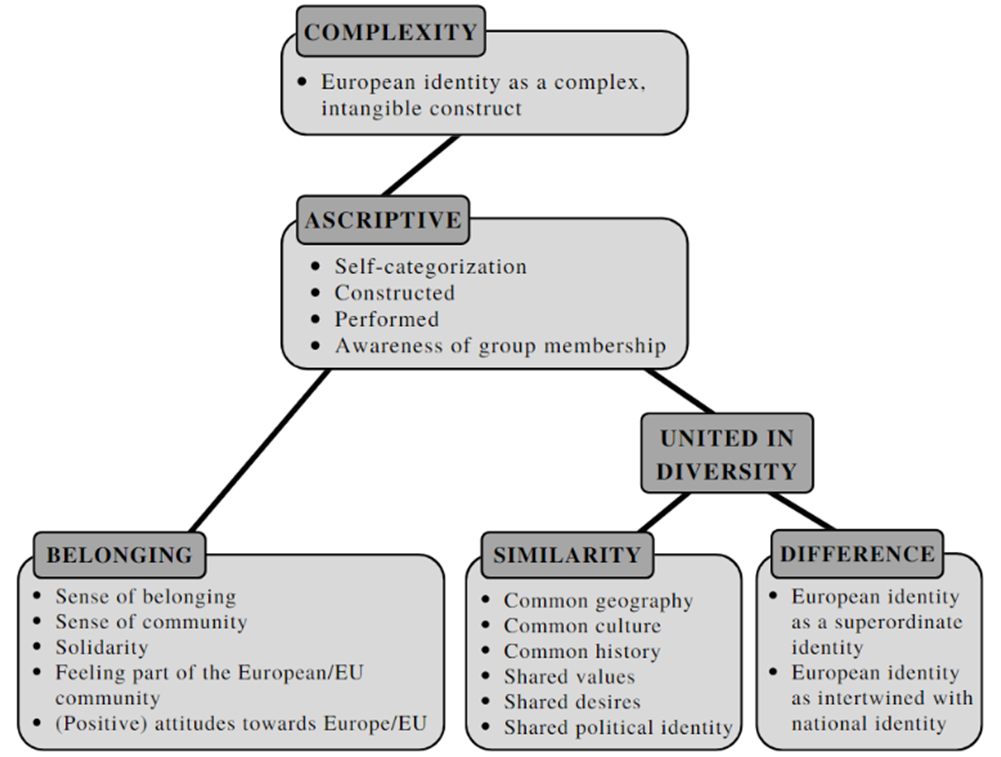
| But, how is a European identity fostered? What implications does a European identity bring for those youth who hold it dear? School-based interventions and tailored curricula can contribute to stronger European identification among youth, though effects vary based on group membership and status. Artistic programmes give insight into European identity construction among younger children. Knowledge about Europe and the EU give rise to stronger European identification, though political trust and the benefits of EU membership are stronger influences. Cross-border experiences through travel and friendships, and higher socio-economic status contribute to stronger identification. In terms of the implications of European identity in youth, two main benefits have been identified: more positive intergroup attitudes and political participation. There is a small but growing body of research on European identity among young people. Developing a measurement tool which taps into the complexities of the development of European identity is a fundamental next step in this research. Furthermore, only one study focused on youth under age 12, pointing to the need to study childhood. Given the promising findings of school-based interventions, and the effect of such a (potentially) unifying identity on social inclusion and political participation, this is an exciting area for future research for the 142 million young people living in Europe today. |
| Post by Isabelle Nic Craith and Laura K. Taylor. Published on the Social Change Lab |
*While working on this project, Isabelle Nic Craith was supported by an Enterprise Ireland grant [R23442] and a UCD Seed Funding grant [SF2025] to Laura K. Taylor
Videos
This short video summarizes our previous international research and collaboration! Meet the Helping Kids! team and hear some of our research backgrounds, questions, and findings.
Shownotes
Episode Title
The Helping Kids! Podcast
Episode Description
Could children helping and sharing with members of diverse social groups be the seed to promoting greater peace and reconciliation across the island of Ireland?
Helping Kids! is an international lab, collecting data in five different countries (Republic of Ireland, Northern Ireland, Kosovo, Republic of North Macedonia and Israel), exploring children’s intergroup empathy and prosocial behaviours framed by the Developmental Peacebuilding Model.
Join researchers at the Helping Kids! lab as they discuss how uncovering the developmental, individual, family, and contextual factors related to children’s empathy and helping behaviours could help to future-proof peace.
This episode will also feature interviews with Sara Singleton from the Dublin-based Think-Tank for Action on Social Change (TASC), and Lynn Johnston from the Northern Ireland Council for Integrated Education (NICIE), both of whom will explore the potential societal impact of Helping Kids! research.
In this episode, researchers at the Helping Kids! Lab and members of our Local Advisory Committee (LAC) will discuss:
Introduction to the Helping Kids! Lab [00:07].
Bethany Corbett– How can we increase host-children’s empathy towards refugees? How does children’s awareness of symbols and labels influence their helping behaviour in divided societies? [03:24].
Dearbháile Counihan- Children’s awareness of the Traveller community in Ireland- can children recognise cultural symbols when physical differences are not present? [10:25].
Laura K. Taylor- Promoting children’s inclusive peacebuilding in Northern Ireland and the Republic of Ireland- how studying children’s early helping behaviours across group lines could be the seed to building a society that respects all identities and traditions across the island [15:08].
Isabelle Nic Craith- What does collecting data for Helping Kids! studies entail, and how can playing interactive games with kids have implications for a more harmonious society? [18:54].
Dean Polly– Day-to-day experience of working as a Helping Kids! Data Collection Assistant [21:50].
Lynn Johnston- The importance of integrated education for promoting peace and reconciliation across Northern Ireland, and the potential value of Helping Kids! research and tools for supporting the goals of NICIE [23:26].
Sara Singleton- How TASC works to transform research into action to promote greater reconciliation across the island of Ireland, and the societal impact of Helping Kids! for harnessing youth’s potential for future peacebuilding [31:07].
Funding and Acknowledgements [33:00].
Find out more about the Helping Kids! lab
- Website: https://helpingkidslab.com/
- Bluesky: @helpingkidslab.bsky.social
Learn more about our Local Advisory Committe
- Northern Ireland Council for Integrated Education (NICIE): https://www.nicie.org/
- Think-Tank for Action on Social Change (TASC): https://www.tasc.ie/
- Cross Border Orchestra of Ireland (CBOI): https://peaceproms.com/
- Migrant and Minority Ethnic Council (MME): https://www.mmecouncil.org/
References and Additional Resources
- Taylor, L. K., & Glen, C. (2020). From empathy to action: Can enhancing host-society children’s empathy promote positive attitudes and prosocial behavior towards refugees? Journal of Community and Applied Social Psychology, 30(2), 214-226.
- Taylor, L.K., Dautel, J., & Rylander, R. (2020). Symbols and labels: Children’s awareness of social categories in a divided society. Journal of Community Psychology, 48(5), 1512-1526.
- Counihan, D., Carol, S., & Taylor, L. K. (2022). Children’s awareness of ethnic outgroup symbols: Piloting an instrument in the Republic of Ireland. International Journal of Psychology. Advance online publication.
- Moran, D., & Taylor, L. K. (2021). Outgroup prosocial behaviour among children and adolescents in conflict settings. Current Opinion in Psychology, 44, 69-73.
- Taylor, L.K. (2020). The Developmental Peacebuilding Model (DPM) of children’s prosocial behaviors in settings of intergroup conflict. Child Development Perspectives, 14(3), 127-134.
- Taylor, L. K., Tomašić Humer, J., & Dautel, J. B. (2022). Predictors of outgroup empathy among children in a conflict-affected society. Children and Society, 36, 949– 967.
- Shamoa-Nir, L., Razpurker-Apfeld, I., Dautel, J.B., & Taylor, L.K. (2020). Outgroup prosocial giving during childhood: The role of ingroup preference and outgroup attitudes in a divided society. International Journal of Behavioral Development, 45(4), 337–344.
- Taylor, L.K., Dautel, J., Maloku, E., & Tomovska Misoska, A. (2021). Children’s outgroup prosocial giving in settings of intergroup conflict: The developmental role of ingroup symbol preference. Developmental Psychology, 57(8), 1350–1358.
- Tomovska Misoska, A., Taylor, L.K., Dautel, J.,& Rylander, R. (2020). Children’s understanding of ethnic group symbols: Piloting an instrument in the Republic of North Macedonia. Peace & Conflict: Journal of Peace Psychology, 26(1), 82-87.
- Lennon Malbasha, L., Dautel, J., & Taylor, L.K. (in press). Exploring children’s knowledge of Irish and European Symbols: A comparison of Gaelscoil and English-speaking primary school children. Irish Educational Studies.
- Taylor, L.K., O’Driscoll, D., Dautel, J., & McKeown, S. (2020). Empathy to action: Child and adolescent outgroup attitudes and prosocial behaviors in a setting of intergroup conflict. Social Development, 29(2), 461-477.
Funders
- The Irish Research Council “New Foundations Award” in partnership with the Department of Foreign Affairs (Reconciliation Fund). https://research.ie/
- The Embassy of Switzerland in Ireland https://www.eda.admin.ch/countries/ireland/en/home/representations/embassy.html
Edited, mixed, and produced by Zach Deering:
Podcast
Could children helping diverse social groups be the seed to promoting peace and reconciliation?
Find out more about how we strive to future-proof peace by tuning into The Helping Kids! Lab podcast on Spotify!
Media
Videos
Launch Event with An Taoiseach for TASC dialogues on a Shared Ireland
News Articles
HEAD TOPICS. Children identify with religious symbols from early age, 30/06/2022.
News Break. Young children identify with political symbols – research, 30/06/2022.
DailyAdvent.com. Young children identify with political symbols – research, 30/06/2022.
BBC Online. Young children identify with political symbols – research, 30/06/2022.
RTÉ.ie. Children identify with religious symbols from early age, 30/06/2022.
The Sunday Times. Children in Northern Ireland learn sectarian differences by age five, 22/03/2020.
Radio
RTÉ Radio 1 (Circulation : 1393000). RTE Radio 1, Drivetime, 01/07/2022.
BBC Radio Ulster (Circulation : 524000). BBC Radio Ulster, The Nolan Show, 30/06/2022.
BBC Radio Ulster (Circulation : 524000). BBC Radio Ulster, The Connor Phillips Show, 30/06/2022
U105 (Circulation : 174000). U 105.8, Breakfast Show, 30/06/2022.
U105 (Circulation : 174000). U 105.8, Frank Mitchell, 30/06/2022.
U105 (Circulation : 174000). U 105.8, Lunchtime Bistro, 30/06/2022.
Podcasts
Newstalk (Circulation : 769000). Newstalk, Moncrieff with Sean Moncrieff, 30/06/2022
The Conversation, 09/04/2018, 2018.
Television
BBC Northern Ireland. BBC 1 NI, Breakfast, 30/06/2022
BBC Northern Ireland. BBC 1 NI, BBC Newsline; Weather, 30/06/2022
Five year olds 'know symbols associated with Northern Ireland traditions'.
Children as young as five years old in Northern Ireland are already aware of the symbols that mark out the region’s two political and cultural communities, according to new academic research.
Conducted by researchers Dr Laura K Taylor, Dr Jocelyn Dautel and Risa Rylander from University College, Dublin and Queen’s University, Belfast, the research looked at how more than 200 children reacted when asked to label a range of symbols.
Participants were given an iPad and asked to label symbols as being either Irish/British or Catholic/Protestant.
Among the symbols were images of flags, such as the Union flag and the Irish Tricolour, shamrock, and poppies, as well as items used in cricket, hurling and rugby.
The researchers found that the children – who were between five and 11 years old – were more likely to sort symbols by tradition than they would have if their decisions had been made randomly.
The UCD/QUB research paper, called ‘Symbols and Labels: children’s awareness of social categories in a divided society’, is published in the Journal of Community Psychology.
Speaking to the Belfast Telegraph last night, lead researcher Dr Laura K Taylor said: “How and when children develop an understanding of group boundaries has implications for conflict resolution.”
She hoped the research would inform education policy and teaching in Northern Ireland.
“Our research is trying to help understand what it means for children to grow up in a post-accord society. Children today did not grow up in a violent society, so how do they learn about it?
“These findings suggest that, by late childhood, children in Northern Ireland can readily identify and associate symbols with their hypothesised social categories.”
Separate school systems, as well as strong family networks and homogeneous lifestyles, shape children’s cultural awareness, the researchers suggest.
The UCD/QUB research echoes a 2002 study for the Community Relations Council, which found children as young as three were able to recognise symbols as being linked to either loyalist or nationalist cultures.
That earlier study – carried out by the University of Ulster – found that by the age of six, 69% of the more than three hundred children surveyed could identify flags and parades as belonging to one ‘side’ or the other.
Reporter, S. (2020, March 23). Five year olds ‘know symbols associated with Northern Ireland traditions’. Published in the Belfast Telegraph.
Children in Northern Ireland learn sectarian differences by age five.
Coyle, C. (2020, March 21). Children in Northern Ireland learn sectarian differences by age five. Published in The Sunday Times.
Publications
Taylor, L.K., Dautel, J., & *Rylander, R. (2020). Symbols and labels: Children’s awareness of social categories in a divided society. Journal of Community Psychology.
*Glen, C., Taylor, L.K. & Dautel, J. (2020). Promoting prosocial behaviour toward refugees: Exploring the empathy-attitude-action model in middle childhood. In N. Bavlin & D. Christie (Eds.), Children and Peace: From Research to Action (pp. 71-87). Switzerland: Springer Peace Psychology Book Series.
Taylor, L. K., & *Glen, C. (2020). From empathy to action: Can enhancing host-society children’s empathy promote positive attitudes and prosocial behavior towards refugees? Journal of Community and Applied Social Psychology, 30(2), 214-226.
Taylor, L.K., *O’Driscoll, D., Dautel, J., & McKeown, S. (2019). Empathy to action: Child and adolescent outgroup attitudes and prosocial behaviors in a setting of intergroup conflict. Social Development.
Tomovska Misoska, A., Taylor, L.K., Dautel, J., & *Rylander, R. (2020). Contact, conflict and interethnic attitudes among children in North Macedonia. Primenjena Psihologija, 12(4), 409-428. doi:10.19090/pp.2019.4.409-428.
Tomovska Misoska, A., Taylor, L.K., Dautel, J.,& *Rylander, R. (2019). Children’s understanding of ethnic group symbols: Piloting an instrument in the Republic of North Macedonia. Peace & Conflict: Journal of Peace Psychology.
(*Supervised student author)
Children’s awareness and understanding of conflict-related groups in divided education systems
Over 420 million children live in conflict-affected areas. Conflict greatly disrupts education, with long-lasting negative effects even after peace agreements are signed. Northern Ireland (NI), Kosovo and Macedonia are settings of protracted conflict in which the primary conflict-related groups remain largely segregated, particularly across schools and neighbourhoods. As a result, the overt conflict in each setting has continued to affect children born after the peace agreements, or in the ‘post-accord generation’.
The Helping Kids! Lab has conducted comparative research in primary schools in each of these settings. We study how majority and minority children in separate education systems develop an understanding about conflict-related groups. We argue that sharing across group lines can be considered an antecedent of later peacebuilding potential in children.
All three settings have education systems divided by group background (NI: Protestant/British, Catholic/Irish; Kosovo: Albanian, Serbian; Macedonia: Macedonian, Albanian). Our trained experimenters visited primary schools and played child-friendly games on a laptop or tablet. These games asked children about their recognition of and preference for images, symbols and names associated with each background in that context. Additionally, the games measured participants’ contact with, attitudes about, and sharing with outgroup children.
Social identity development theory (SIDT), which acted as a framework for this research, centres on children’s ethnic identity development having four (potential) phases: undifferentiated, ethnic awareness, ethnic preferences and ethnic prejudice; the shift between these phases is informed by social context. Across the three settings, our findings supported these phases. In each setting, participants were evenly split by gender and background (NI: 529 pupils; 263 male, 266 female; ages 5–11 [M=7.8, SD=1.76; 46.4% Protestant, 53.6% Catholic]; Kosovo: 219 pupils; 108 male, 111 female; ages 6–10 [M=8.07, SD=1.33; 54.3% Albanian, 45.7% Serbian]; Macedonia: 199 pupils; 107 male, 92 female; ages 6–11 [M=8.40, SD=1.41; 44.2% Macedonian, 55.8% Albanian]).
In each setting, children readily recognised the social cues associated with conflict-related groups. For example, in NI, children identified poppies as British and shamrocks as Irish; in Kosovo, children consistently categorised murals and pop artists as Albanian or Serbian; and in Macedonia, children distinguished celebratory foods as Macedonian or Albanian.
Overall, the more aware children were of conflict-related group markers as belonging to one group versus the other, the more children preferred ingroup symbols. That is, children with higher awareness of group symbols also expressed greater preference for ingroup images, supporting the link between ethnic awareness and preference in SIDT. Children who preferred ingroup symbols shared fewer resources (that is, stickers) with outgroup children. Children who reported more positive experiences with and attitudes about outgroup children, however, shared more resources with outgroup children.
The Helping Kids! lab will continue to identify antecedents of children’s peacebuilding in divided societies. Fostering positive outgroup attitudes and opportunities for outgroup helping may have promising, long-term implications for more constructive intergroup relations. Through discussions with families, schoolteachers and administrators, non-governmental organisations and government officials, we hope our findings can inform public policies that aid children living in conflict-affected areas around the world. As a result, our findings may help inform peacebuilding interventions in schools and communities, with the long-term aim of fostering more cohesive societies.
Post by Laura K. Taylor, Alexandra Jacobs, Jocelyn Dautel, Risa Rylander, Ana Tomovska Misoska, and Edona Maloku.
Published on the BERA Blog.
 Helping Kids!